Join our newsletter
If you run a busy dental office, you’ve probably tried a tool that promised to save hours and ended up giving your team one more thing to manage. Still, AI in dentistry is already taking real manual work off dental teams, and 43.3% of dentists use it for at least one task, according to a July 2026 ADA Health Policy Institute survey. The harder part is knowing which tools will pull their weight in your practice before you commit.
How is AI used in dentistry?
The most useful AI tools don’t try to practice dentistry. They clear the bottlenecks before, during, and after the visit, so your team isn’t stuck catching up after close.
Here are a few common examples, in the order they come up during a typical day:
Before the first patient: insurance verification
For the front desk, insurance verification is one of the most manual, repetitive parts of the day. Practices use AI to check insurance eligibility ahead of each appointment and follow up with payers when details are missing. That means fewer hours on hold for the front desk, and the only calls left for them are the plans that insist on talking to a person.
Chairside: imaging
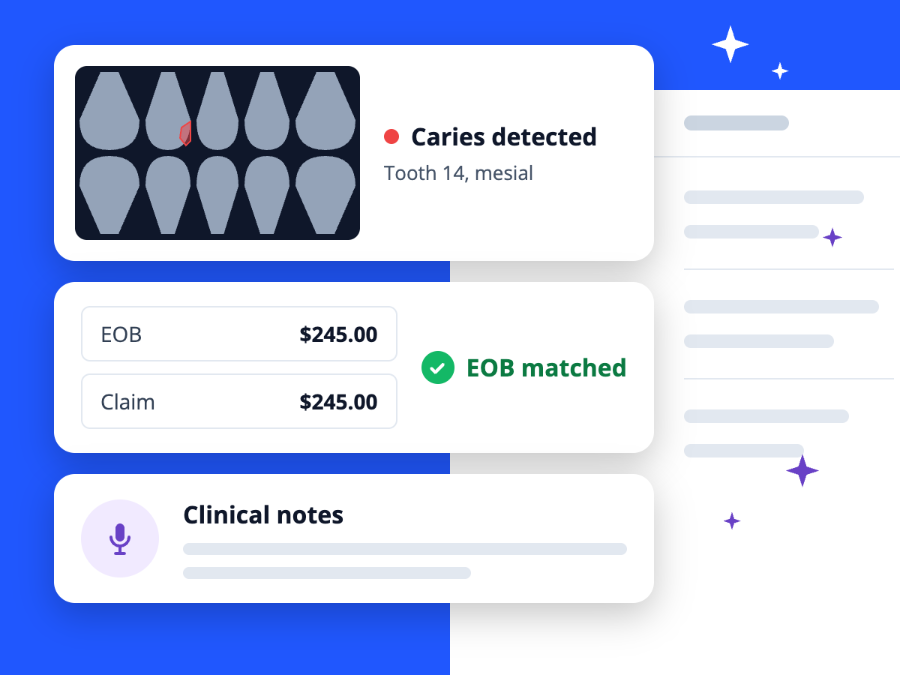
Dentists don’t need AI to read a radiograph, but a consistent second look on every x-ray helps, no matter how full the schedule gets. FDA-cleared AI imaging, like Pearl, outlines possible caries, bone loss, and calculus, and patients can see what the dentist sees when they talk through treatment.
Between patients: clinical notes and voice perio
Charting is the task dentists say they most want help with, and it's no surprise, since it's usually the work that follows them home. Practices use an ambient dental scribe to draft the note during the exam. The note gets finished in the operatory, so the dentist stays focused on the patient instead of the keyboard. They still review, edit, and sign every note, and they stay accountable for what’s in the chart. For hygiene teams, voice perio records probing depths into the chart as the hygienist calls them out, so assistants can stay in their own operatories.
Important note: Always let patients know when an ambient scribe is listening, and check your state's recording consent and AI disclosure laws.
After close: insurance payment posting
Payment posting isn’t as flashy as imaging, but the office manager will notice. With automated insurance payment posting, the system matches payments from ERAs and paper EOBs to open claims and posts the clean ones, and exceptions and partial payments go to the billing team for review. Ledgers update daily, so staff time goes to resolving denials.
A few other places AI is showing up in dental practices:
- Front desk: AI phone answering and check-in tools pick up after-hours calls, routine questions, and intake forms.
- Marketing and writing: General-purpose tools like ChatGPT and Claude are handy for social posts, patient letters, office policies, and job postings. Just keep patient information out of them.
- Reporting and analytics: AI can summarize production and collections trends, flag patients with unscheduled treatment or overdue recall, and answer plain-language questions about your numbers, so the team isn't digging through menus to build a report.
What are the benefits of AI in dentistry?
When AI tools actually pull their weight, the payoff shows up in your schedule, your charts, and how early your team locks the doors at night.
More of the day goes to patient care. When repetitive admin work shrinks, that time goes back to the parts of the job that need people: patient conversations, treatment planning, and running the schedule.
In Archy's data, for example, practices using Archy Scribe save about 5 minutes per patient, which at 15 patients a day adds up to roughly 20 hours a month for one dentist.
Fewer missed details. People get busy; software doesn’t skip steps on a packed day. Records, claims, and ledgers stay more complete and consistent, which means fewer missing attachments, unrecorded perio depths, or billing errors to fix after close.
Faster, cleaner collections. Complete, consistent records give claims a better shot at going through the first time. And when payment posting keeps pace with the schedule, you know what’s been paid and what needs follow-up without waiting for month-end.
For Archy Revenue users, posting time drops from about 2 minutes a claim to under 30 seconds, with 95% matching accuracy. At 200 claims a month, for example, that’s almost 7 hours of posting down to under 2.
A lighter load on a stretched team. If you’re short-staffed, AI picks up work that would otherwise fall on the same few people, so you can handle a growing patient load without adding to payroll right away.
Should you use built-in AI or standalone tools?
For dental practice AI automation, where the AI lives decides how much time it actually saves. Whether a tool is built into your practice management system (PMS) or added on, ask three questions before you commit:
- Does it write straight into the patient record, or does someone have to copy results over?
- Does it need its own login and its own sync?
- Does it add another vendor and another BAA to manage?
Every extra step eats into the time the tool was supposed to save. That’s why AI tends to work best inside the system your team already uses, working from one consistent source of data. It’s the approach we took at Archy, where AI agents work from the same patient record as everything else in your system.
How to automate a dental practice with AI
The best way to know if AI will save your team time is to try it. Pick one workflow, run it for a month or two, and compare it against how things work today. If the numbers move, keep going. If they don't, you've lost very little.
Here's how to run the test:
- Pick one tool or feature to test. Start where your team feels the most friction, like insurance calls, EOB posting, or charting. Ask your front desk and hygienists what they'd hand off first.
- Get a baseline. Time how long it takes to do 10 eligibility checks, EOB postings, or clinical notes manually. Multiply that by your weekly volume so you know what “better” looks like.
- Keep your team in control. Most tools let you choose what gets handled automatically and what gets flagged for a person. Then pick one person to own the test.
- Confirm the BAA. Make sure it's signed before the tool touches live patient data.
- Run a 30- to 60-day trial. Let your team know the tool is there to help, not to grade anyone. Check in for 15 minutes a week and spot-check a handful of completed tasks.
- Expand when it's working. Agree up front on what "working" means, such as an error rate no worse than your manual baseline, then move to the next tool or feature.
See built-in dental AI in action
If you're already on Archy, each AI feature turns on separately, so you can test one workflow without disrupting the rest of the office. If you're still managing an on-premise server and separate add-ons, Archy brings imaging AI, ambient scribing, voice perio charting, and payment posting into one cloud system. Explore Archy AI.
Frequently Asked Questions
Is AI going to replace dentists?
No, artificial intelligence will not replace dentists because dental care requires physical procedures, clinical judgment, and patient trust that software cannot replicate. According to the ADA, fewer than 5% of dentists use AI for treatment recommendations, keeping diagnostic and treatment decisions firmly with the clinician.
What is the best AI for dentistry?
The best dental AI depends on which operational or clinical bottleneck slows your office down most. Front-desk teams often start with automated eligibility verification and payment posting, while clinicians often start with ambient scribes, voice perio charting, and FDA-cleared imaging AI.
Are insurance companies using AI to review claims?
Many are. Payer claim systems are highly automated, and many claims are processed without a person reviewing them. Because those systems check for missing clinical support, incomplete narratives can lead to denials. Pairing an ambient scribe with automated payment posting helps claims carry complete documentation and flags denials as soon as the ERA arrives.
Will using AI make patient care feel impersonal?
No, dental AI can make visits feel more personal by removing administrative distractions during the exam. Back-office tools run invisibly on insurance checks and payment posting, while chairside tools like ambient scribes let dentists maintain eye contact instead of typing notes.
Is AI worth the cost for a dental practice?
Yes, when the recovered staff hours or added clinical production outweigh the monthly software fee. Administrative savings are easy to calculate. For example, if payment posting saves 5 hours a month at $30 an hour, that’s about $150 a month. The bigger value is what your front desk does with those hours. Time spent calling patients with unscheduled treatment or overdue recall can book visits worth far more than the wages saved.
How do you know if AI is paying off?
Compare your team's output after 30 to 60 days against how long those same tasks took before you used AI. Look for fewer hours spent on manual tasks, faster turnaround on routine work, and fewer errors requiring rework. If nothing has moved after 60 days, revisit the setup.